The Colosseum is the most visited monument in the world. Nearly seven million people walk through its archways every year, drawn by photographs they have seen since childhood and by something harder to name — a pull towards the ancient, the dramatic, and the colossal. But what most visitors see only scratches the surface of a story that spans nearly two thousand years.
This is the full history of the Colosseum — from the political ambition that built it, to the blood sport that filled it, the earthquakes that cracked it, the medieval transformation that stripped it, and the ongoing restoration that preserves it. By the end, you will understand not just what the Colosseum is — but what it has always meant.
Colosseum — Key Facts
- Official name: Flavian Amphitheatre (Amphitheatrum Flavium)
- Construction began: 70–72 AD under Emperor Vespasian
- Inaugurated: 80 AD by Emperor Titus
- Capacity: estimated 50,000–80,000 spectators
- Dimensions: 188m long, 156m wide, 48–50m tall
- Material: travertine limestone, Roman concrete, brick, tuff
- Arena floor size: approximately 83m x 48m
- UNESCO World Heritage Site since 1980
- One of the New Seven Wonders of the World (2007)
Why Was the Colosseum Built?
To understand the Colosseum, you first have to understand what stood in its place before it. In 64 AD, the Emperor Nero — infamous for his vanity, cruelty, and alleged delight in watching Rome burn — seized a vast stretch of central Rome after the great fire and built himself a palace complex of extraordinary scale. He called it the Domus Aurea, the Golden House. At its heart sat an artificial lake, surrounded by gardens, fountains, vineyards, and rooms decorated in gold leaf, ivory, and frescoes.
The Roman people hated it. A private imperial pleasure palace occupying land that had belonged to the city felt like an act of tyranny dressed as architecture. When Nero died in 68 AD, disgraced and abandoned, the political opportunity was obvious. His successors understood that reclaiming that land — and giving it back to the people — would be enormously popular.
"Where the detested palace of a cruel tyrant once glittered, Rome is restored. Where once Nero's lake was, now stands the Colosseum."
Vespasian, the first emperor of the Flavian dynasty, drained Nero's lake and began construction of a great amphitheatre in its place. The message was deliberate and unmistakable: the land stolen by Nero was being returned to Rome as a gift. Entertainment for the masses, built on the ruins of imperial excess.
See History For Yourself
Walk where gladiators stood. Book your Colosseum tickets before your Rome visit — skip the queue, secure your date.
Book Colosseum Tickets →Construction: Building the Impossible
Construction of the Flavian Amphitheatre began around 70–72 AD. The engineering achievement it represents is almost impossible to overstate. The Romans were building the largest amphitheatre in the world at a speed that modern construction teams would respect.
The workforce was enormous. Roman sources suggest it included tens of thousands of Jewish slaves — prisoners captured during the Siege of Jerusalem in 70 AD, brought to Rome as the spoils of Titus's military campaign in Judea. Skilled Roman craftsmen, engineers, and free labourers worked alongside them. The project was, by any measure, a feat of organised imperial power applied to stone.
The Colosseum used multiple materials in a precise structural system. The outer and inner walls are travertine limestone — a pale, warm stone quarried at Tivoli, 30 kilometres from Rome. The internal radial walls used Roman concrete and tuff (volcanic stone). Bricks filled the spaces between. The combination created a structure flexible enough to absorb movement and load without catastrophic failure — a principle that has kept it standing for nearly two thousand years.
The outer facade rose to four levels. The first three featured the three classical orders of columns — Doric on the ground floor, Ionic on the second, Corinthian on the third — decorating the 80 arched openings that punctuated each level. The fourth level was a solid wall punctuated by windows, with projecting corbels to support the velarium — a vast retractable awning that could shade the audience from the Roman sun. It was operated by sailors from the Roman fleet using a system of ropes and pulleys that has never been fully replicated.
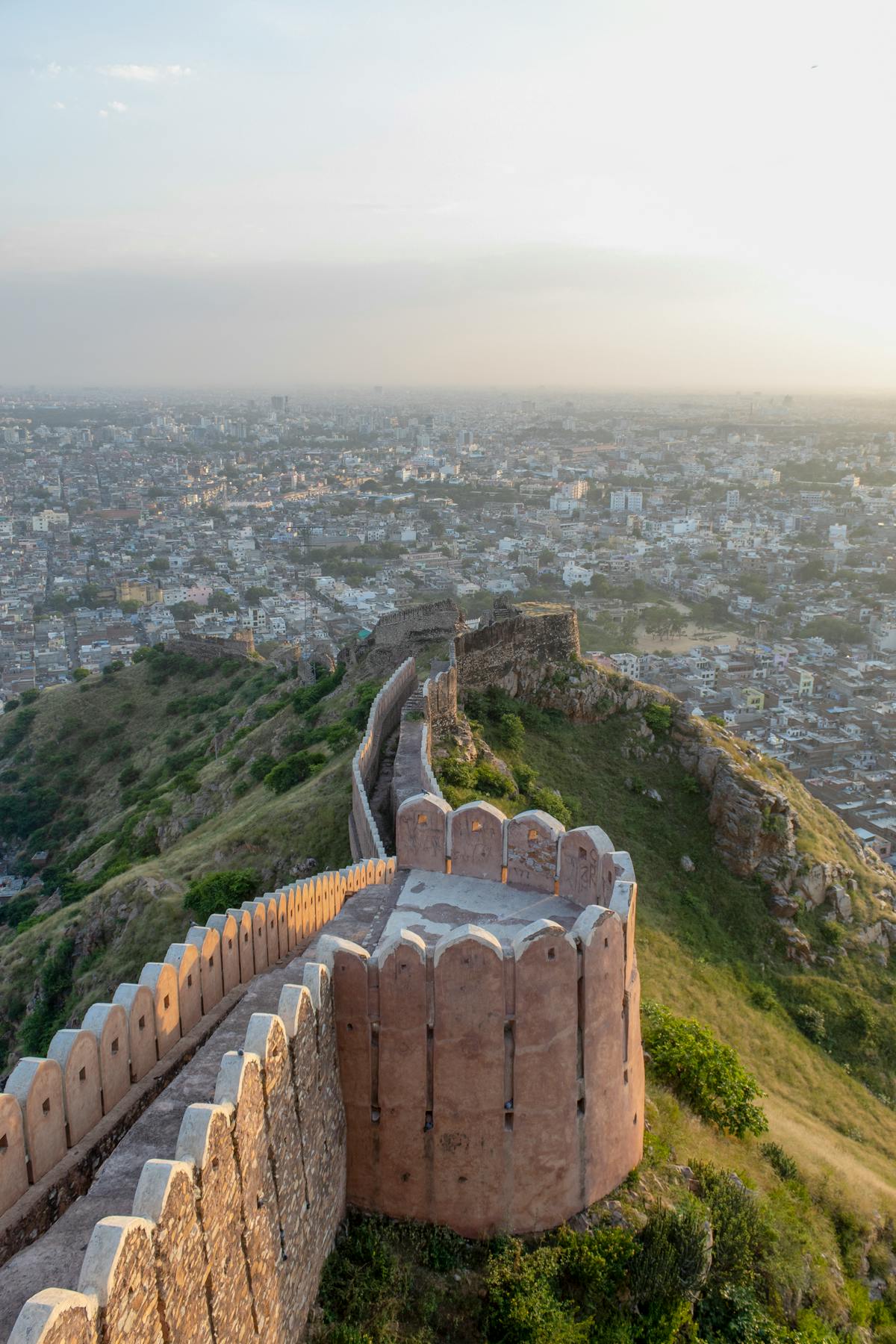
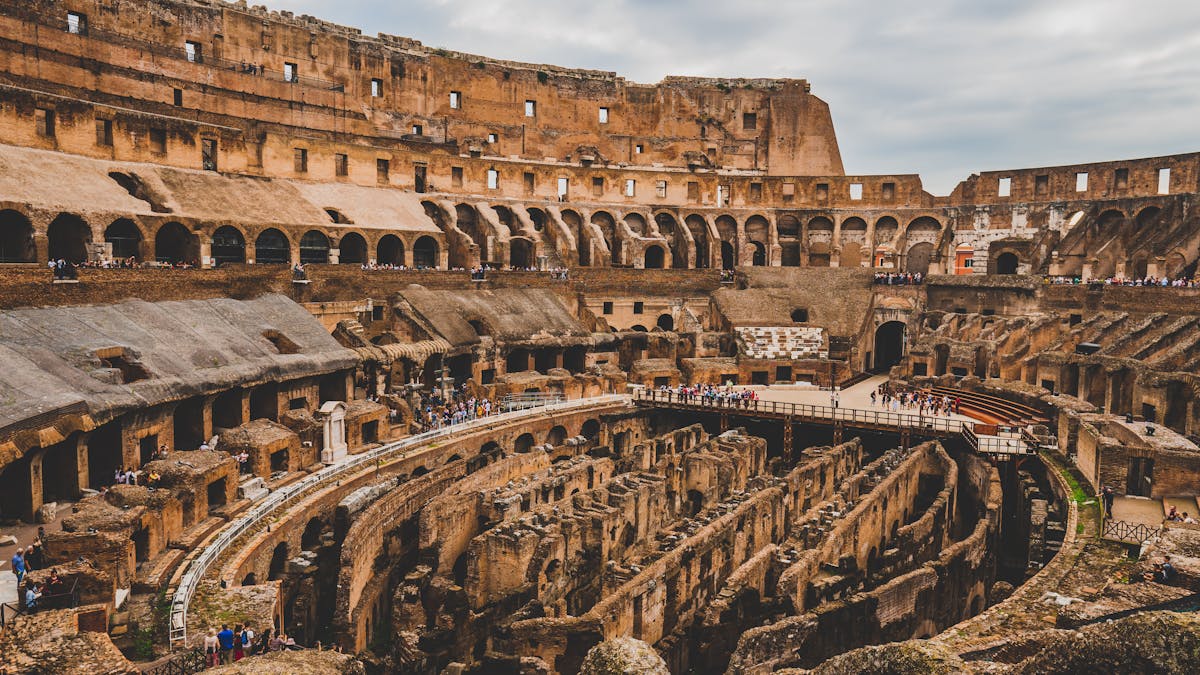
The exposed hypogeum — the underground network of tunnels and chambers hidden beneath the arena floor for most of the Colosseum's active history.
The Inauguration: 100 Days of Games
Vespasian died in 79 AD before the Colosseum was complete. His son Titus finished it and inaugurated the amphitheatre in 80 AD with games that reportedly lasted 100 days. The ancient sources — Cassius Dio, Suetonius, and others — describe spectacles of extraordinary scale and variety: gladiatorial combat, wild animal hunts (venationes), executions of condemned criminals, theatrical performances, and even a recreation of a naval battle (naumachia), with the arena temporarily flooded with water.
Nine thousand animals were said to have been killed during the inaugural games. Whether this number is precise or exaggerated, it signals something important: the Colosseum was not just a building. It was a statement of imperial power, Roman identity, and the relationship between the emperor and his people.
The Emperors Who Shaped the Colosseum
Different emperors left their mark on the structure and the spectacles it hosted. Some added new features. Some used it cynically for political control. Some are remembered for particularly extreme events.
Ordered construction on the site of Nero's lake. The political symbolism — returning stolen land to the people — was deliberate and powerful.
Completed and inaugurated the Colosseum in 80 AD with 100 days of games. Oversaw the completion of the upper levels and the hypogeum underground.
Added the fourth level and the underground hypogeum — the network of tunnels beneath the arena floor that made the elaborate spectacles possible.
Reportedly fought personally as a gladiator in the arena, always winning against opponents who were instructed not to harm him — a fact Romans found deeply undignified.
Carried out significant restoration work after earthquake damage in 217 AD and expanded the arena floor to allow for more elaborate naval spectacles.
Officially banned gladiatorial combat in 399 AD following the spread of Christianity and the famous intervention of the monk Telemachus, who reportedly died trying to stop a fight.
Gladiators: The Reality Behind the Legend
Gladiators are the Colosseum's most enduring image — and one of its most misunderstood. The popular picture of a Hollywood gladiator — a muscular free warrior fighting to the death every week for the entertainment of bloodthirsty crowds — is mostly fiction. The reality was more complicated, more commercial, and in some ways more interesting.
Most gladiators were slaves, prisoners of war, or condemned criminals. Some, however, were free volunteers — men who signed away their freedom in exchange for the financial security of a gladiatorial contract. Gladiators were expensive to train and maintain, and their death was a genuine financial loss. Owners and promoters preferred injured fighters to dead ones wherever possible.
Gladiators lived in dedicated training schools (ludi) attached to or near the arena. The Ludus Magnus — the largest and most important — was built directly adjacent to the Colosseum and connected to it by an underground tunnel. Gladiators trained daily, ate specialist high-calorie diets, received medical care, and were something between athletes and property.
Types of Gladiator
Secutor — heavily armoured, with a smooth helmet and large shield. Usually paired against the Retiarius.
Retiarius — fought with a net, trident, and dagger. Minimal armour, maximum agility. The crowd's favourite and the fighter most likely to be jeered as unmanly for his light protection.
Murmillo — a heavily armed fighter with a fish-crested helmet and large shield, typically matched against the Thraex.
Thraex — armed with a small curved sword and small shield. Nimble, aggressive, crowd-pleasing style.
Hoplomachus — fought in the style of a Greek hoplite, with spear, short sword, and round shield.
The "thumbs up / thumbs down" decision of the crowd and emperor at the end of a fight is historically uncertain — ancient sources describe the crowd indicating mercy or death by the position of the thumb, but exactly what gesture meant what has been debated for centuries. What is clear is that the crowd's reaction mattered, and that a fighter who had performed well could earn his reprieve regardless of the result.
Gladiatorial combat declined sharply in the early 5th century as the Roman Empire Christianised and the theological and cultural arguments against public bloodsport gained force. The last recorded gladiatorial games in the Colosseum took place in 404 AD.
Wild Animal Hunts and Other Spectacles
Gladiatorial combat was not the only entertainment the Colosseum hosted. Venationes — staged hunts of wild animals — were enormously popular and drew crowds as large as any gladiatorial bout. Lions, tigers, leopards, bears, crocodiles, elephants, rhinoceroses, giraffes, hippopotamuses, and ostriches were shipped to Rome from across the empire and beyond. The death toll on animals over four centuries of games is estimated in the hundreds of thousands.
The morning programme typically featured animal hunts. Midday executions of criminals — often staged as dramatic mythological re-enactments — followed. Gladiatorial combat filled the afternoon. It was, in modern terms, a full day event.
The machinery that made these spectacles work was the hypogeum — the underground network beneath the arena floor. A system of lifts, ramps, pulleys, and trapdoors allowed animals to be raised directly into the arena without the audience seeing where they came from. Fighters could appear from nowhere. Scenery could be changed. The effect was theatrical, surprising, and designed to maximise impact on 80,000 people who had been sitting in the sun for hours.
The Roman Forum, directly adjacent to the Colosseum — the political heart of the empire that funded and attended the games.
Decline: Earthquakes, Abandonment and Stripping
The fall of the Western Roman Empire in 476 AD did not immediately end the Colosseum's use. Animal hunts continued until at least 523 AD under the Ostrogothic king Theodoric. But without the imperial machine that had funded, organised, and populated the spectacles, the Colosseum's purpose gradually dissolved.
Major Fire and Earthquake Damage
A lightning strike caused a fire that destroyed the wooden upper seating. Earthquake damage followed. Repairs continued for decades under successive emperors.
End of Gladiatorial Games
Following the spread of Christianity and the intervention of the monk Telemachus, Emperor Honorius officially banned gladiatorial combat. Animal hunts continued for another century.
Converted to Housing and Cemetery
Parts of the Colosseum were converted into housing. The arena floor became a Christian cemetery. The structure's identity as an entertainment venue faded.
Major Earthquake Damage
A severe earthquake caused the collapse of the entire south outer wall — which remains missing today. The south side's missing exterior is still the most visually obvious scar of the Colosseum's long history.
Used as a Fortress and Quarry
Noble Roman families used the Colosseum as a fortified stronghold. The Frangipane and Annibaldi families both occupied it at different times. Its stone was systematically stripped for use in other buildings — including St Peter's Basilica and the Palazzo Venezia.
Pope Benedict XIV Declares It Sacred
Pope Benedict XIV halted the stripping of stone by declaring the Colosseum sacred ground — a memorial to the Christian martyrs believed (though historically disputed) to have died there. This effectively ended centuries of looting.
First Archaeological Excavations
Pope Pius VII and later Pope Leo XII commissioned the first systematic excavations. The hypogeum underground was gradually uncovered for the first time since the medieval period.
The Stone Quarry of the Middle Ages
The stripping of the Colosseum's stone is one of the more painful chapters in its history. Across several centuries, an estimated two-thirds of the original structure was removed and repurposed. The iron clamps that held the travertine blocks together were pried out, leaving the pockmarked holes that still cover the surface of the stone today — one of the Colosseum's most distinctive visual features and a direct record of medieval salvage operations.
The travertine, marble, and other materials from the Colosseum were used in some of Rome's most famous buildings: the foundations and columns of St Peter's Basilica contain Colosseum stone. The Palazzo Venezia, the Palazzo Barberini, and numerous churches and bridges across Rome were built partly from material stripped from the ancient monument.
It is estimated that if the Colosseum had not been stripped, it would today be almost entirely intact.
Christian Martyrs: History vs Legend
The popular belief that the Colosseum was a site of Christian martyrdom — that thousands of early Christians were thrown to lions in the arena for refusing to renounce their faith — is one of the most persistent stories attached to the monument. It is also historically contested.
Modern historians have found no contemporary evidence specifically placing Christian martyrdoms in the Colosseum. There were certainly Christian executions in Rome's amphitheatres during the periods of imperial persecution, but direct evidence linking the Colosseum specifically as a site of such executions is thin. The story became established largely through medieval tradition, particularly after Pope Benedict XIV's 1749 declaration of the site as sacred to Christian martyrs.
The belief shaped how the Colosseum was treated and ultimately helped preserve it — which makes it historically significant regardless of its accuracy. Today a large cross stands in the arena as a symbol of this tradition, and the Pope leads the Via Crucis (Way of the Cross) procession at the Colosseum each Good Friday.
Experience 2,000 Years of History In Person
The Colosseum Underground reveals the hidden world beneath the arena floor — where gladiators and animals waited before the spectacles began.
Book Underground Tickets →The Colosseum Today: Restoration and Preservation
The Colosseum is one of the most intensively studied and restored ancient structures in the world. Since the 19th century, successive campaigns of archaeological excavation, structural reinforcement, and conservation work have stabilised and partially restored the monument.
In 2016, a major restoration of the exterior — funded by the fashion house Tod's — was completed, removing centuries of grime and biological growth from the travertine facade. The result, a warmer, cleaner stone surface, surprised many Romans who had grown up with the darker version. In 2023, a new retractable arena floor was installed — allowing the arena level to be restored to something closer to its original appearance and enabling events to be held in the space for the first time in centuries.
The Colosseum is managed by the Parco Archeologico del Colosseo, which also oversees the Roman Forum, Palatine Hill, and several other ancient sites in the area. It remains one of Italy's highest-earning cultural attractions, with ticket revenue funding ongoing restoration and preservation work.
The Colosseum as a Symbol
Beyond its history as a venue for entertainment, the Colosseum has become one of the world's most powerful symbols. It appears on the Italian one-cent, two-cent, and five-cent euro coins. It is the symbol of Rome itself — used on everything from city branding to international tourism campaigns. It was named one of the New Seven Wonders of the World in 2007 following a worldwide vote.
It also carries darker symbolic weight. Anti-death penalty campaigners have used the Colosseum as a focal point — every time a country abolishes the death penalty, the monument is lit in gold rather than white at night, a tradition begun in 2000. The colour change has happened dozens of times since and turned the Colosseum into an unlikely contemporary symbol of human rights advocacy.
Nearly two thousand years after its construction, the Colosseum continues to mean something — not just as a monument to Roman engineering genius or imperial ambition, but as a mirror in which every era sees something of itself.
Frequently Asked Questions
Ready to Visit the Colosseum?
Book your tickets before your Rome trip — skip the queue and guarantee your entry date.
Book Colosseum Tickets →